Research highlight: Factors that are barriers and promotors of successful return to work for common mental health disorders.

I am one of the coordinators for the Psychology Law Evidence Database (PLED), a comprehensive, continuously updated, freely available database of selected scientific papers about psychology and law for policy makers, stakeholders, the general public, practitioners, and researchers.

One recently published study featured on the PLED, “Meta-synthesis of qualitative research on return to work among employees with common mental disorders” provides a synthesis of qualitative research for factors that are barriers to successful return to work and things that promote a successful return to work.

Some findings include:

  • ongoing impairments from mental and physical symptoms
  • difficulty setting limits after returning to work, even if gradual, despite knowing the accommodation/modification to their position was important for effective coping
  • reduced work hours alone was not sufficient for a successful return to work, other accommodations were needed (e.g., modified responsibilities and workload).

I particularly appreciate the authors efforts to frame the barriers and promotors of successful returns in the biopsychosocial model. The authors state (pp. 100-101):

Our meta-synthesis identified obstacles in all three components of the [biopsychosocial] model: i) exhaustion, reduced concentration, and forgetfulness can be seen as an obstacle at the biological level; (ii) perfectionism, a high sense of responsibility and low self-efficacy can be seen as obstacles at the psychological level; and (iii) low social support and lack of coordination between the systems can be seen as obstacles at the social level.”

Abstract:

Objectives The purpose of this study was to investigate which opportunities and obstacles employees with common mental disorders (CMD) experience in relation to return to work (RTW) and how they perceive the process of returning to work. In addition, the study explores what characterizes an optimal RTW intervention and points to possible ways to improve future interventions for employees with CMD. Methods A systematic literature search was conducted, and eight qualitative studies of medium or high quality published between 1995-2011 were included in this systematic review. The eight studies were synthesized using the meta-ethnographic method.
Results This meta-synthesis found that employees with CMD identify a number of obstacles to and facilitators of returning to work related to their own personality, social support at the workplace, and the social and rehabilitation systems. The employees found it difficult to decide when they were ready to resume work and experienced difficulties implementing RTW solutions at the workplace.
Conclusions This study reveals that the RTW process should be seen as a continuous and coherent one where experiences of the past and present and anticipation of the future are dynamically interrelated and affect the success or failure of RTW. The meta-synthesis also illuminates insufficient coordination between the social and rehabilitation systems and suggests how an optimal RTW intervention could be designed.

Andersen, M. F., Nielsen, K. M., & Brinkmann, S. (2012). Meta-synthesis of qualitative research on return to work among employees with common mental disorders. Scandinavian journal of work, environment & health, 93-104.

For information on the article and other psychology law evidence on various topics see the Psychology Law Evidence Database.


PLEDweb_large

Research highlight: Risk assessment & Cultural Diversity

I am one of the coordinators for the Psychology Law Evidence Database (PLED), a comprehensive, continuously updated, freely available database of selected scientific papers about psychology and law for policy makers, stakeholders, the general public, practitioners, and researchers.

One recently published study featured on the PLED, “Forensic risk assessment and cultural diversity: Contemporary challenges and future directions” highlights the importance of cultural diversity in violence risk assessments.

Abstract:

A Canadian Federal court recently impugned the administering of 5 risk assessment instruments with Canadian Aboriginal prisoners. The ramifications of the ruling for the field are notable given the universal employment of risk instruments with Indigenous offenders and patients. Effectively, forensic clinicians and researchers can no longer overlook the role of culture in risk assessment–a robust academic dialogue on this subject matter is consequently warranted. This article explores how culture can shape the entire risk assessment process; from instrument construction and validation, to risk marker sensitivity, symptom articulation, and client-clinician interaction. Future directions for cross-cultural assessment are discussed

Shepherd, S. M., & Lewis-Fernandez, R. (2016). Forensic risk assessment and cultural diversity: Contemporary challenges and future directions. Psychology, Public Policy, And Law, 22(4), 427-438. doi:10.1037/law0000102

For information on the article and other psychology law evidence on various topics see the Psychology Law Evidence Database.

PLEDweb_large

A different take on coping with holiday stress: How to have a miserable holiday, tips from psychologist Dr. Randy Paterson

Dr. Randy Paterson from Changeways Clinic shared his tips on how to have a miserable holiday with CBC earlier this month.

Dr. Paterson’s post highlight some of the tips from the CPA on coping with holiday stress, but rather than focused on how to cope, it focuses on how to increase the chance you will be  miserable this holiday season.

1. Fuel relationship fantasies

2. Cast a Christmas special

3. Drink too much, often

4. Have the expectations of a five-year-old

5. Overcommit to everything

For the full article click here.

About Changeways

Changeways Clinic is a psychologist-owned counselling and psychotherapy service in Vancouver Canada. Changeways provides therapy services to help people deal with a wide range of challenges, including depression, anxiety, panic, obsessive compulsive disorder, eating disorders, parenting, sexuality, and problems associated with major life changes, including transitions, bereavement, and coping with pain and health issues. We also provide coaching for enhanced life satisfaction.

I am one of the 14 psychologists that provide therapy services at Changeways.

Check out the Changeways site for more information and how to make an appointment.


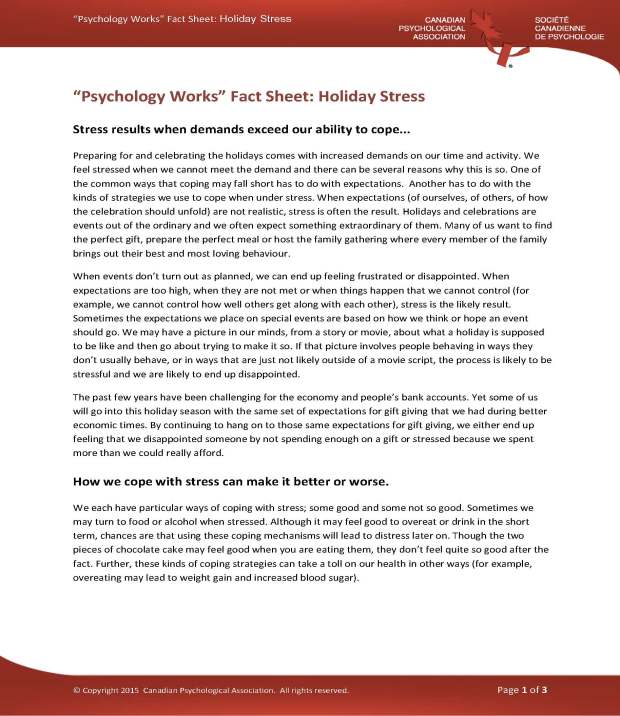
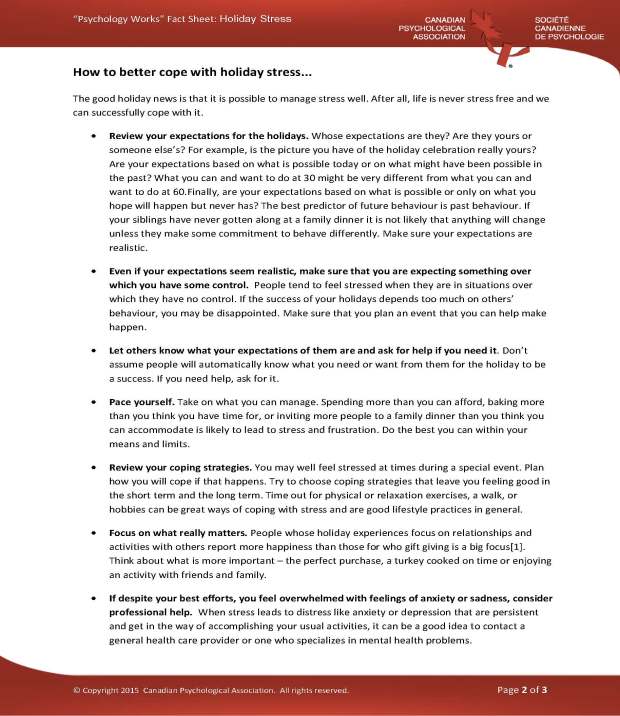
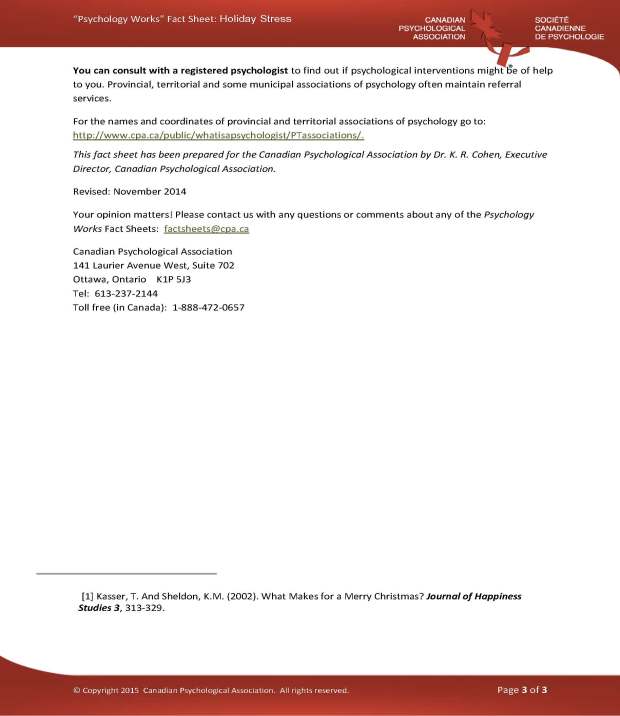
Coping with holiday stress

Review your expectations 

Pace yourself

Focus on what really matters

December is here and that means holiday activities, event, and expectations for many of us. The Canadian Psychological Association has a great short “Psychology Works” fact sheet for tip on how to manage holiday stress. Be sure to review early as many of these strategies help to prevent the experience of stress over the holidays. Tips for coping with stress including: review your expectations, pace yourself, and focusing on what really matters. Check out the full fact sheet here.

PsychologyWorksFactSheet_HolidayStress_Page_1PsychologyWorksFactSheet_HolidayStress_Page_2PsychologyWorksFactSheet_HolidayStress_Page_3

“Heads Up Guys” – A resource for managing and preventing depression

The University of British Columba and the Movember Foundation have teamed up to offer a resource website called “Heads Up Guys” offering information for managing and preventing depression. The site is geared toward men, “for men, about men” as the site says.

Many people are familiar with the Movember campaign, and Heads Up Guys has been funded in part by the Movember Foundation. One target of the foundation is men’s mental health and suicide prevention.

For more information on Heads Up Guys read about the project here.


Home

Brain Injury Resource Alert: brainstreams.ca

A resource dedicated the sharing of information on acquired brain injury in BC provides tons of helpful information on brain injury: http://www.brainstreams.ca

From “Concussion 101” facts, to where to find resources in your community, the site provides a comprehensive, easy to use platform for getting information on brain injury.

The site also features videos, including this older, but great overview of brain injury from GF Strong called “What is a brain injury?”. Check it out!


Mental Health at Work, Oct 10th is World Mental Health Day!

The theme for World Mental Health Day is mental health in the workplace.

Looking internationally, the Mental Health Foundation in the UK offers a guide for how to support mental health at work. For the full guide see this link.

Recommendations from the Mental Health Foundation guide include:

  1. Talk about your feelings

  2. Keep active

  3. Eat well

  4. Drink sensibly

  5. Keep in touch

  6. Ask for help

  7. Take a break, etc.

See also my post on 13 Factors that Can Impact Mental Health in the Workplace from Mental Health Commission of Canada.