Research highlight: Post-traumatic Stress Disorder as a consequence of bullying at work and at school

I am one of the coordinators for the Psychology Law Evidence Database (PLED), a comprehensive, continuously updated, freely available database of selected scientific papers about psychology and law for policy makers, stakeholders, the general public, practitioners, and researchers.

One recently published study featured on the PLED, “Post-traumatic Stress Disorder as a consequence of bullying at work and at school: A literature review and meta-analaysis” provides a review of the development of PTSD from bullying in work and school contexts. The authors highlight that based on their study:

  • “The majority of victims reports symptoms of PTSD.

  • Exposure to bullying is cross-sectionally associated with symptoms of PTSD.

  • No longitudinal studies and few studies with clinical diagnosis.

  • It is not possible to determine causal associations between bullying and PTSD based on existing literature.”


Abstract:

Bullying has been established as a prevalent traumatic stressor both in school and at workplaces. It has been claimed that the mental and physical health problems found among bullied persons resembles the symptomatology of Post Traumatic Stress Disorder (PTSD). Yet, it is still unclear whether bullying can be considered as a precursor to PTSD. Through a review and meta-analysis of the research literature on workplace- and school bullying, the aims of this study were to determine: 1) the magnitude of the association between bullying and symptoms of PTSD, and 2) whether the clinical diagnosis of PTSD applies to the consequences of bullying. Altogether 29 relevant studies were identified. All had cross-sectional research designs. At an average, 57% of the victims reported symptoms of PTSD above thresholds for caseness. A correlation of .42 (95% CI: .36-.48, p b .001) as found between bullying and an overall symptom-score of PTSD. Correlations between bullying and specific PTSD symptoms were in the same range. Equally strong associations were found among children and adults. Two out of three identified clinical diagnosis studies suggested that bullying is associated with the PTSD diagnosis. Due to a lack of longitudinal research and structural clinical interview studies, existing literature provides no absolute evidence for or against bullying as a causal precursor of PTSD.

Nielsen, M. B., Tangen, T., Idsoe, T., Matthiesen, S. B., & Magerøy, N. (2015). Post-traumatic stress disorder as a consequence of bullying at work and at school. A literature review and meta-analysis. doi: http://dx.doi.org/10.1016/j.avb.2015.01.001

For information on the article and other psychology law evidence on various topics see the Psychology Law Evidence Database.

PLEDweb_large

Research Highlight: The aftermath of workplace violence among healthcare workers

I am one of the coordinators for the Psychology Law Evidence Database (PLED), a comprehensive, continuously updated, freely available database of selected scientific papers about psychology and law for policy makers, stakeholders, the general public, practitioners, and researchers.

One recently published study featured on the PLED, “The aftermath of workplace violence among healthcare workers: A systematic literature review of the consequences” provides a review of the consequences of violence among healthcare workers. The authors highlight that:

“Psychological (e.g., posttraumatic stress, depression) and emotional (e.g., anger, fear) consequences and impact on work functioning (e.g., sick leave, job satisfaction) were the most frequent and important effects of workplace violence.”

Abstract:

Workplace violence is an important health and safety issue. Healthcare workers are particularly at risk of experiencing workplace violence. Despite the research that was conducted in this domain, little is known about the consequences of being a victim of workplace violence, specifically in the healthcare sector. Therefore, this article aims to review the literature regarding the consequences of exposure to workplace violence in the healthcare sector. Sixty-eight studies were included in the review and they were evaluated according to 12 criteria recommended for systematic reviews. The studies identified seven categories of consequences of workplace violence: (1) physical, (2) psychological, (3) emotional, (4) work functioning, (5) relationship with patients/quality of care, (6) social/general, and (7) financial. Psychological (e.g., posttraumatic stress, depression) and emotional (e.g., anger, fear) consequences and impact on work functioning (e.g., sick leave, job satisfaction) were the most frequent and important effects of workplace violence. In conclusion, this paper recommends further research, particularly longitudinal studies, in order to better grasp the direct and indirect effects of workplace violence.

Lanctôt, N., & Guay, S. (2014). The aftermath of workplace violence among healthcare workers: A systematic literature review of the consequences. Aggression and violent behavior, 19(5), 492-501.

For information on the article and other psychology law evidence on various topics see the Psychology Law Evidence Database.
PLEDweb_large

New Consensus Statement on the Role of Exercise and Physical Activity in Closing the Life Expectancy Gap for People with Mental Illness

A client of mine brought this to my attention recently. This statement hits the main points on why examining both mental and physical health is so important.

The Role of Sport, Exercise, and Physical Activity in Closing the Life Expectancy Gap for People with Mental Illness: An International Consensus Statement by Exercise and Sports Science Australia, American College of Sports Medicine, British Association of Sport and Exercise Science, and Sport and Exercise Science New Zealand

Check it out here: https://journals.lww.com/acsm-tj/Fulltext/2018/05150/The_Role_of_Sport,_Exercise,_and_Physical_Activity.1.aspx

Resource: ‘Your Journal To Mental Wellness’

I recently came across a resource intended for young Canadians called “Walk Along”. Put together by UBC and Bell Let’s Talk, walk along has a new take on internet mental health.

From the site walkalong.ca:

What is WalkAlong?

WalkAlong isn’t your typical mental health website. We are a community where young Canadians can explore their mental health amongst their peers. At WalkAlong we believe wellness comes from empowerment and we like to see WalkAlong as a companion; someone to walk along with you during your journey to better mental health. This portal is a Canadian-based mental health resource that also provides information and links to existing mental health care resources for friends & family members.

Ongoing consultation with young Canadians and expert health care professionals guarantees the continued development of a cutting-edge, robust, comprehensive, and appropriate web resource. We hope that WalkAlong will support you and your support network in taking a more empowering role in the managing your well being.


Check it out! 

Psychology Today on the Research Behind the Benefits of Meditation

A recent article in Psychology Today outlines the research on the benefits of meditation.

Meditation is ‘hot’ right now and many of us don’t fully understand the scientific reasons, rather then the popular reasons, it is good for us.

The article chunks the benefits into a few groups:

  • it boosts your health
  • it boosts your happiness
  • it boosts your social life
  • it boosts your self-control
  • it changes your brain
  • it improves your productivity
  • it makes you wise(r)
  • it keep you real

Check out the fully article from Psychology Today here: “20 Scientific Reasons to Start Mediating Today”.

For more information on mindfulness mediation and therapy see this piece by Dr. Lau of the Vancouver CBT Centre.

WHO training tools for human rights in mental health services

The World Health Organization (WHO) has launched training tools for health care workers and those receiving mental health care on human rights within mental health care.

The overview from the WHO website states:

“As part of the QualityRights Initiative, WHO has developed a comprehensive package of training and guidance modules. The modules can be used to build capacity among mental health practitioners, people with psychosocial, intellectual and cognitive disabilities, people using mental health services, families, care partners and other supporters, NGOs, DPOs and others on how to implement a human rights and recovery approach in the area of mental health in line with the UN Convention on the Rights of Persons with Disabilities and other international human rights standards.”

All of the tools can be found at this link.

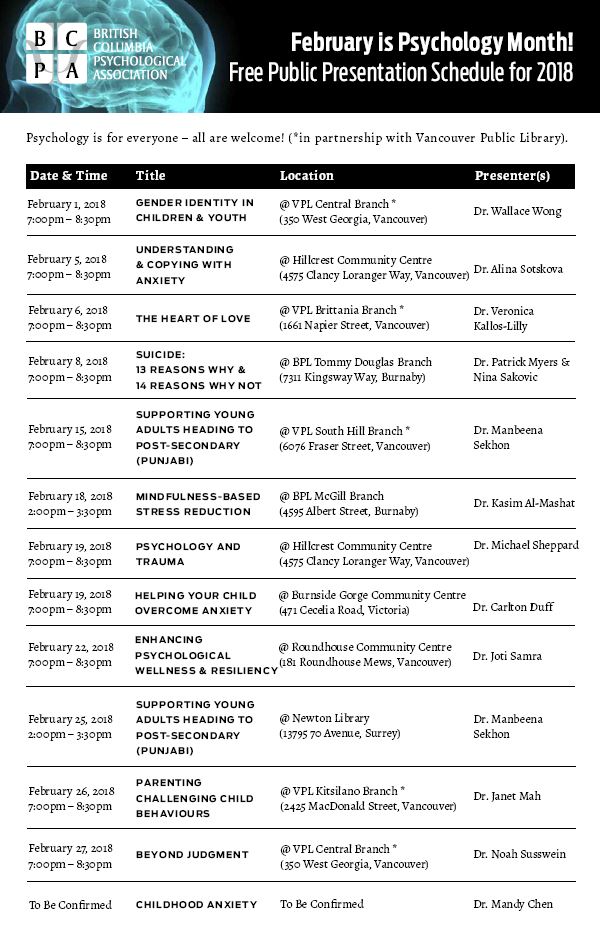
Free presentations in BC for Psychology Month, starting Feb 1.

February is Psychology Month!

The BC Psychological Association is hosting 13 free talks on hot topics in psychology in Vancouver, Burnaby, Surrey, and Victoria all through the month of February.

Topics cover a wide range of interested including gender identity, anxiety, suicide, mindfulness, wellness and resiliency, and judgement.

psych month sched - jan 18 2018

For more information see the BCPA website: https://www.psychologists.bc.ca/blog/psychologymonth